
Photo credit: Daily Trust
By Ozumi Abdul
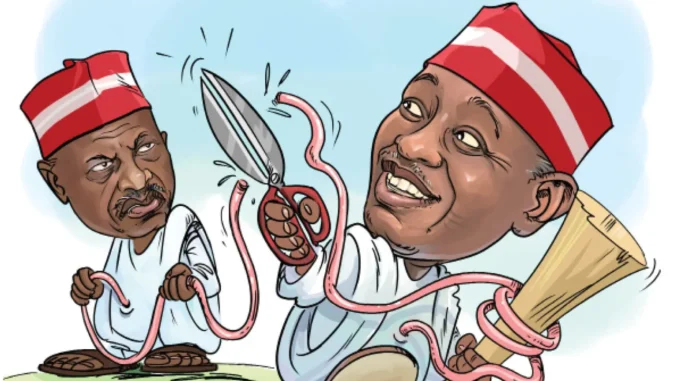
To understand the current political storm in Kano, one must first discard a comforting illusion: there is no grand strategy, no secret pact, no hidden choreography between Governor Abba Kabir Yusuf and his political mentor, Senator Rabiu Musa Kwankwaso, over the governor’s impending defection to the All Progressives Congress (APC).
What is unfolding is not a clever double game. It is a slow, noisy, and deeply consequential political divorce.
In the last few days alone, the signs have been unmistakable. Local government stakeholders suddenly convening to publicly endorse Abba’s planned defection, while simultaneously appealing to Kwankwaso to “come along.” Press statements, media interviews, carefully staged gatherings, declarations of loyalty and public pleas for unity. All of it deliberate. All of it coordinated.
But the messages are not meant for President Bola Tinubu. They are not meant for APC power brokers like Abdullahi Umar Ganduje. And they are certainly not meant for the blind, unquestioning followership—the makafi base. The audience is one man: Rabiu Musa Kwankwaso.
In Nigerian politics, a sitting governor does not need this kind of drama to defect. Once there is buy-in from the State Assembly, local government chairmen and a critical mass of stakeholders, defection is usually quiet, swift and announced as a fait accompli. No rallies. No persuasion tours. No public begging.
So when you see this level of noise, choreography and pressure, it tells you something important: Kwankwaso is not aligned. These gatherings are not symbols of unity; they are instruments of pressure. They are designed to force a convergence that does not yet exist.
And even if Kwankwaso were, against all odds, to eventually defect, it would not be because he chose to. It would be because the political weight around him became unbearable. But anyone who understands Kwankwaso’s political psychology knows this much: he is not wired for reluctant obedience.
This is why Kano feels tense again.
The state is no stranger to political uncertainty. From the era of the late Muhammadu Abubakar Rimi, when Kano first learned the cost of defying entrenched power to the fierce Ganduje–Kwankwaso rivalry that split the state down the middle, Kano’s politics has always been combustible. What makes this moment particularly historic is that it pits a political movement against itself.
The planned defection of Governor Abba Kabir Yusuf from the New Nigeria Peoples Party (NNPP) to the ruling APC has thrown the Kwankwasiyya Movement into confusion. Multiple sources told VERITY NEWS that the governor’s decision is “irreversible,” even if it leads to a complete rupture with Kwankwaso, the founder of the movement and the man who played a decisive role in Abba’s emergence as governor in 2023.
The shock is profound. Not just within Kano, but across the country. That Abba would consider joining the APC, the same party that includes his bitter rival, former governor Abdullahi Umar Ganduje has stunned political observers. This is the same Ganduje whose administration Abba has repeatedly tried to probe for alleged corruption, moves insiders say were taken without Kwankwaso’s approval.
Yet for those close to the governor, the decision is rooted less in emotion than in survival.
Political insiders who spoke to VERITY NEWS point to Abba’s traumatic post-election experience as a turning point. Though he won at the ballot in 2023, the APC prevailed at the tribunal and the Court of Appeal. Abba reclaimed his mandate only after a ferocious legal battle at the Supreme Court.
“He doesn’t want a repeat of that,” one source told VERITY NEWS. “He fought too hard. He doesn’t want to govern under constant threat.”
That fear has been compounded by the broader political environment. Almost all governors elected on opposition platforms have since defected to the APC. In such a climate, remaining outside the ruling party carries institutional risks Abba appears unwilling to take.
But internal NNPP politics may have been the final push.
According to a senior aide who spoke on condition of anonymity to VERITY NEWS, the governor concluded that the NNPP had become an unreliable platform riddled with litigation and factional battles.
“The major reason is that the NNPP is no longer viable,” the source said. “Even if the governor stays, Kwankwaso’s inner circle has decided he would not get the ticket. Their plan is to give the deputy governor the chance.”
The aide went further, alleging that resistance to Abba’s second term stems from fears that his growing profile and visible projects across Kano could eclipse Kwankwaso’s legacy.
“They don’t want him to outshine Kwankwaso. His work is visible, and they don’t want him to continue.”
If true, then the rupture was inevitable.
The movement itself is now split down the middle. On one side is the Kwankwaso loyalist bloc, reportedly consisting of the deputy governor, the NNPP’s only senator, two commissioners, the governor’s political adviser and the NNPP state chairman. On the other is Abba’s camp: 23 commissioners, 19 members of the House of Assembly, the Speaker, 13 members of the House of Representatives and all 44 local government chairmen.
This second bloc is said to be coordinated by the Speaker, the ALGON chairman and the governor’s director-general of protocol, a structure that mirrors power, not sentiment.
Former Speaker of the Kano State House of Assembly, Rt Hon. Kabiru Alhassan Rurum, now a House of Representatives member and recent APC defector, confirmed meeting with the governor to discuss the planned defection.
“Throughout our discussion, we never talked about Kwankwaso,” Rurum said bluntly. “We discussed strategic issues around the governor’s defection, but nothing about Kwankwaso’s movement.”
That statement alone underscores how far things have fallen apart.
Kwankwaso, sources say, has not taken the news well. A closed-door meeting with the Speaker was reportedly a last-ditch attempt to halt the process. A source close to him said the former governor was deeply disappointed and initially struggled to believe Abba would openly defy him.
“That press conference by the NNPP chairman was Kwankwaso’s immediate response,” the source said. “But from all indications, the defection is concluded. They are only hoping the governor reconsiders.”
The roots of this crisis predate the current drama. Before President Bola Tinubu’s inauguration, Kwankwaso reportedly explored negotiations with the APC for a possible alliance that would secure him a role in the federal government. The talks collapsed after the presidency allegedly judged his demands excessive, fearing his influence among northern power brokers ahead of 2031.
After that breakdown, APC leaders reportedly shifted attention to Abba Yusuf through the Progressive Governors’ Forum, an affront Kwankwaso did not take lightly.
“He wanted all negotiations to pass through him,” a source said. “He felt sidelined.”
From that point on, trust eroded.
Meanwhile, NNPP leaders in Kano continue to plead for unity. The state chairman, Hashim Suleiman Dungurawa, has rejected the planned defection, appealing “for the sake of Allah and the Prophet.” Senator Rufa’i Sani Hanga has warned that Kano voters “do not support betrayers.”
But the political ground has already shifted.
Analysts say Abba’s defection will significantly weaken the NNPP, potentially reducing it to a personal platform. For APC, it strengthens numerical advantage but imports new rivalries. For Kwankwasiyya, the test is existential: can a movement built around loyalty and symbolism survive without power?
And looming over everything is the unanswered question: will Kano witness a Rivers-style implosion between Abba and Kwankwaso?
As history has shown since the days of Rimi, Kano’s political conflicts rarely end quietly. Whatever happens next will not only define Abba’s future, but also determine whether the red cap remains a symbol of movement or a relic of power once held and now slipping away.
Ozumi Abdul is a journalist, writer, editor and columnist. He can be reached via abdulozumi83@gmail.com